
India should not stay on the margins of this initiative. There should be a serious debate about what would be in India's best interests asserts former foreign secretary Shyam Saran.
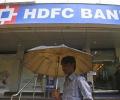
HDFC Bank, India's largest private-sector lender, has revised its FY27 growth trajectory, stepping back from earlier guidance to align with a more measured 12 per cent year-on-year expansion, citing geopolitical uncertainties.

Fixed deposits from nationalised banks delivered higher returns than equities, outperforming both inflation and stock market benchmarks.

The conflict may disrupt Budget 2026-2027 projections, squeezing revenues and raising subsidies, prompting fiscal adjustments and potential reforms, echoing lessons from the Covid-era shock, points out A K Bhattacharya.

Reserve Bank of India (RBI) Governor Sanjay Malhotra stated that preventing second-round effects of supply shocks, where inflation expectations rise due to prolonged disruptions, is the primary role of monetary policy. He also defended the RBI's foreign exchange market interventions, asserting it did not commit to an 'indefensible peg'.

'The West Asia or the Gulf crisis has shown that what we develop as national infrastructure when things are not as bad as they could be, we forget to plan for adversities.'
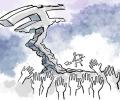
Revenue collection next financial year may be affected, and, along with this, subsidies on food and fertilisers can go up if the war in West Asia drags for long, according to experts.

Gross GST collections rose 6.2 per cent to a three-month high of over Rs 1.93 lakh crore in January, indicating increased consumption is making up for rate cuts late last year, sources said on Sunday.

The modern war is about quality over quantity, points out Mihir S Sharma.

A lighthearted joke by comedian Zakir Khan at the Chetak Screen Awards 2026 has ignited a debate within Bollywood about jealousy and artistic contribution following the success of 'Dhurandhar 2'. The film's box office triumph has exposed underlying tensions and prompted discussions about star power and creative content.

Investment proposals for around Rs 1.88 trillion through 35 major agreements, spread across deep tech, green energy, and aerospace, were the hallmark moment of the first day of the two-day "Telangana Rising Global Summit", which started on Monday.

India is the second-most-preferred destination among chief executive officers planning international investments - up from the fifth spot last year, according to PwC's 29th Annual Global CEO Survey released on Tuesday. The United States is their first choice.

The Union Budget for 2026-27 is expected to sketch out a road map for trebling the cooperative sector's contribution to the Indian economy over the next decade, with the aim of bringing 500 million people within its ambit, in line with the objectives of the National Cooperative Policy, 2025.

Governments should move away from universal subsidies towards tightly targeted transfers, backed by stricter eligibility norms, sunset clauses and periodic audits to curb leakages and improve spending efficiency, a joint study by Asian Development Bank and PwC has recommended.

More than 58% of individual housing loans disbursed in 2023-2024 were more than 25 lakh in size.

There is record underperformance and under-ownership. Some of this is cyclical and will turn on its own. However, we also need to regain our growth credentials. For this, both the government and companies have a role to play, as do investors, points out Akash Prakash.

The idea of back-loading the target of fiscal consolidation is perhaps guided by the government's desire to be prepared for any adverse developments in the coming year, points out A K Bhattacharya.

Supported by strong buoyancy in public sector capital expenditure (capex), growth in infrastructure investment is expected to accelerate in 2025-26 (FY26) compared to 2024-25 (FY25), according to the First Advance Estimates of gross domestic product (GDP) for FY26 released by the National Statistics Office (NSO) on Wednesday.

The Indian economy is growing at a robust pace, driven by strong domestic demand, low inflation, and the healthy balance sheets of banks, said a Reserve Bank report released on Wednesday.

India is growing fast, but to keep growing strong, the government must make more things at home, create jobs, and spend money wisely, suggests Rajiv Memani, regional managing partner, Africa-India Region, EY.

Trade deals ease risks for Indian equities, but weak demand and stretched valuations raise questions over whether optimism -- especially in smallcaps -- can turn into a sustained bull run, points out Debashis Basu.

'The real risk is not that AI will fail to transform India's economy.'
'The risk is that it already is -- while our measurement systems continue to look the other way,' observes Nishant Sahdev, a theoretical physicist at the University of North Carolina.

Of the donations, 48% is in kind -- such as food, clothing, or other household goods -- followed by cash (44%) and volunteering (30%) with non-profits, religious institutions, or community groups.

The deal shifts the US posture towards India from hostile to neutral, and that matters for growth, points out T T Ram Mohan.

'We don't have to compete with Maharashtra or Gujarat. We have to now start thinking about how we compete with the United States or China.'

Gross GST collections rose 6.1 per cent to over Rs 1.74 lakh crore in December 2025, even as sweeping tax cuts slowed down growth in revenues from domestic transactions, according to government data released on Thursday.

Hindustan Unilever (HUL) has topped the Perpetual Capital Hurun India Impact 50 - 2026 list with 53.9 points (on the scale of 0-100), reflecting a strong performance across key sustainable development goals (SDGs), including climate, water, circularity, gender and biodiversity.

India has managed high government debt-to-GDP, a slowing domestic revenue engine, lower household savings and a more hostile geopolitical environment separately in the past. But together, they threaten to undo the growth narrative on which today's optimism rests, warns Debashis Basu.

Budget 2026 is an intentional and ambitious one - From manufacturing growth to services supremacy, from technology consumption to AI-powered transformation. This is the blueprint for a $7 trillion economy built on intelligence, not just scale.

'Implementation of GST would lead to the growth story of India'.

In a world fractured by uncertainty, India stands out for its policy consistency, paired with sustained ambition, points out Pritam Banerjee.

Uttar Pradesh, Gujarat and Odisha budgets maintain revenue surpluses despite welfare schemes while Rajasthan and West Bengal face high debt, fiscal deficits and low capital outlay.

Restoring weighted tax deductions and adopting a petty patents regime can foster firm-level innovative activity critical for competitiveness, points out Nagesh Kumar.

After years of rapid expansion, the Centre's capital spending growth eases as private investment shows early signs of revival, points out A K Bhattacharya.

RSS chief Mohan Bhagwat addressed concerns about population imbalance, citing religious conversion, infiltration, and low birth rates as key factors. He advocated for 'ghar wapasi' and vigilance against infiltrators, while also emphasizing the importance of family and employment.

The Planning Commission of India has released the official Gross State Domestic Product figures. The map above shows the GSDP of each state in the year 2013-14 in Rs crore.
The Planning Commission of India has released the official Gross State Domestic Product figures. The map above shows the GSDP of each state in the year 2013-14 in Rs crore.

'We believe the truth is in the middle, and that India is at an important crossroads.'

India needs to increase the investment rate to 34-35 per cent from 31-32 per cent currently to achieve a growth rate of 7 per cent and above, said S Mahendra Dev, chairman, economic advisory council (EAC) to the Prime Minister, on Wednesday.

The Indian economy is likely to grow at 7.4 per cent in 2025-26, up from 6.5 per cent in the previous fiscal, mainly on account of better performance of manufacturing and services sectors, as per the government data released on Wednesday.
